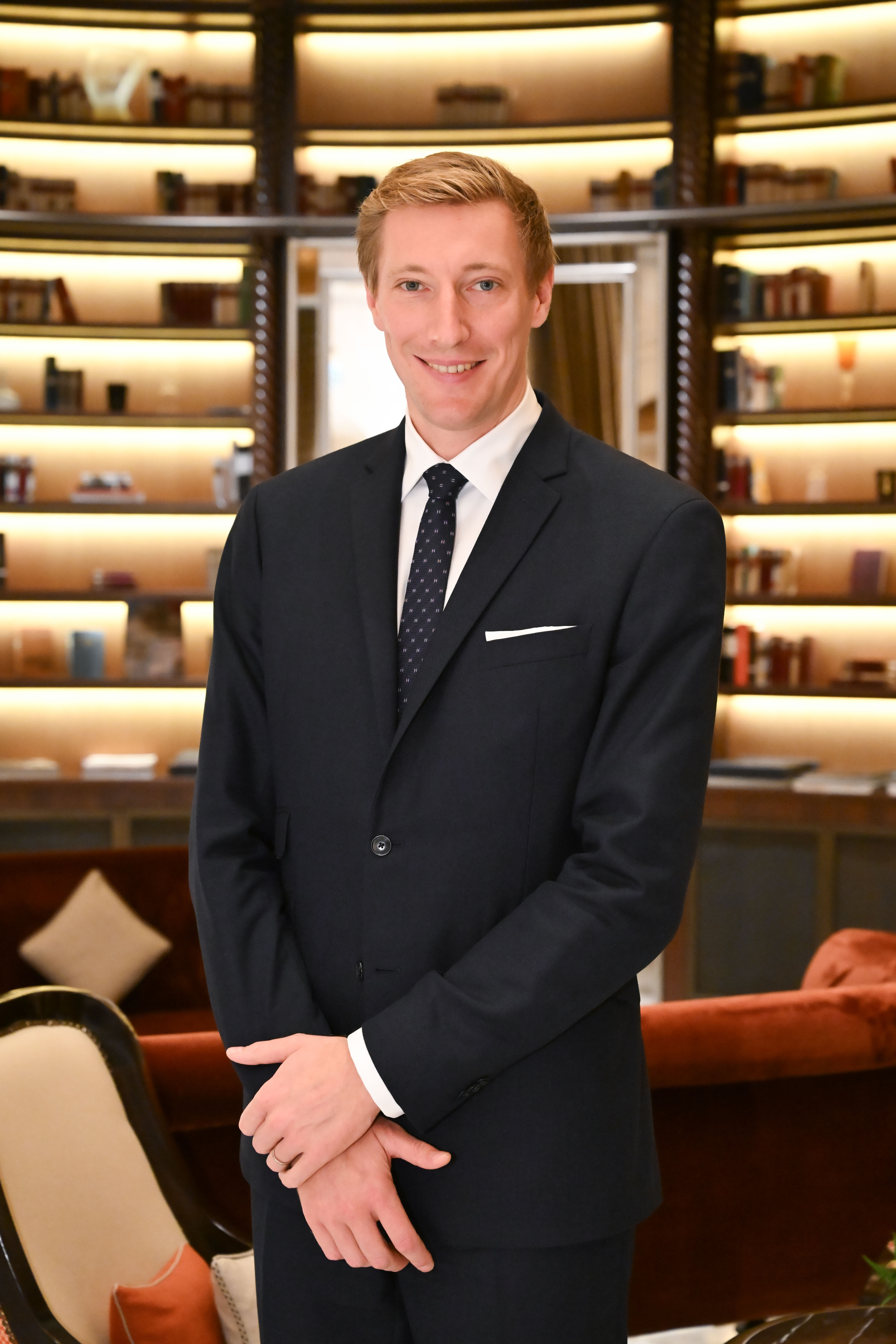
What makes his journey particularly interesting is the intersection of three dimensions:
the precision of operations, the creativity of gastronomy and the ability to bring people together around a shared vision of excellence.
His experience spans Michelin-starred dining, iconic hotel bars, room service, restaurant openings, commercial strategy and team development. These different environments provide rich material for exploring a central question: how does a leader translate demanding standards into authentic hospitality, while allowing both guests and employees to feel genuinely valued?
Hotel Eden offers a particularly relevant setting for this conversation. Its identity combines Roman character, a strong sense of place and an approach to hospitality that values both sophistication and warmth.
Your career began on the floor, in service roles, before taking you into finance, operations and executive leadership. How have those early experiences shaped the way you see hospitality today, and what do you understand about the profession now that you could not have understood from behind a desk?
My professional journey began on the front lines of service, and the vibrant pulse of face-to-face engagement remains the driving force behind my executive vision today. At its core, hospitality is an act of pure guest-centricity. When I first started, the ultimate spark that fueled my passion was the genuine smile of the people we welcomed. It was then that I discovered the beautiful rhythm of this profession: a rare craft where one derives profound fulfillment from orchestrating the joy of others.
From behind an executive desk, it is all too easy to look at spreadsheets and lose sight of the human element. However, my time in active service taught me an undeniable truth: an inspired team is the sole architect of an exceptional guest experience. Energy is inherently contagious. You simply cannot engineer a remarkable guest experience without a team that feels genuinely valued, supported, and inspired. Cultivating fairness for both your team and your guests is the most critical foundation you can build. While finance and operations naturally focus on hard metrics, my years on the floor proved that impeccable service and high standards are merely the baseline. True success lies in the business of creating lifelong memories, sharing our guests' joy, and fostering an environment where we have fun doing it. To truly lead in this industry, you cannot just manage operations; you must touch the hearts of the people.
From the Ritz Paris to Le Meurice and Dorchester Collection, you have worked in some of the most demanding environments in luxury hospitality. Is there a particular encounter, mentor or defining moment that changed your perspective on what it truly means to deliver excellence?
In the world of luxury hospitality, demanding environments teach us early on that excellence has no single mother tongue. My greatest professional evolution wasn't learning to execute a rigid standard of service perfectly, but rather awakening a deep, intuitive cultural fluency. I remain incredibly grateful to the countless mentors who gifted me a true sense of place and opened my eyes to the quiet art of managing global perspectives.
What these spaces teach you is that training only gives you an essential baseline. True excellence begins when the guidelines book ends. It takes flight when you use that foundation to express your own voice and genuine connection. It is entirely a matter of adaptability. For instance, the vibrant, expressive warmth that delights an Italian guest will rarely resonate with a Japanese traveler who values a more measured, subtle cadence of respect. Excellence is the art of the invisible shift—seamlessly altering your energy to decode and mirror the cultural nuances of whoever walks through the door, ensuring everyone finds their own authentic sense of belonging.
At Le Meurice, you led a complex Food & Beverage operation bringing together restaurants, bars, room service, banqueting and pastry. How do you create a shared sense of purpose across such different teams, each with its own rhythm, expertise and identity?
Managing a complex Food & Beverage operation means balancing completely different worlds. Every department naturally has its own unique rhythm, expertise, and distinct identity. The secret to bringing them together lies in a simple, unshakeable philosophy: one
team, one common goal. When everyone channels their unique passion in the exact same direction, achieving excellence becomes inevitable.
To create this shared sense of purpose, you cannot lead by dictating from above; you lead by collaborating. My approach is to always present the ultimate vision to the entire team first, making sure everyone understands where we want to go. But then, crucially, you must give a voice to your people. You listen to the pastry chefs, the bartenders, the housekeeping team and the room service team alike.
By actively involving them in the conversation, you don't just align their different rhythms, you ignite their ownership. Once every voice has been heard and the path forward is clear, that is when we decide together what to do and move forward as a united front.
You have managed teams of very different sizes and backgrounds, from specialist restaurant teams to large, multi-outlet operations. What qualities do you look for when recruiting people, and how do you recognise potential that goes beyond a CV or technical skills?
When recruiting people, my philosophy anchors back to a core truth: you can easily train someone on technical skills, but you cannot teach attitude, energy, and behaviour. Guidelines and standard operating procedures are crucial and important to build a solid expertise, but without an innate willingness to connect, they remain mere instructions on a page. The natural drive, and the warmth a person brings into a room cannot be manufactured. That is what I look for.
Recognizing true potential requires looking far beyond the lines of a CV. I focus on soft skills, particularly how a person reads a situation and adapts to it. In luxury hospitality, the ability to intuitively sense what a guest or a colleague need in a specific moment is everything.
Luxury hospitality demands consistency, precision and attention to detail, often under considerable pressure. How do you maintain exceptional standards while ensuring that your teams feel trusted, supported and able to express their own personality?
Maintaining exceptional standards under pressure isn't about rigid control; it is about building an unshakeable foundation where training is the ultimate pillar. In luxury hospitality, eighty percent of our success comes down to anticipation. The more seamlessly you can anticipate a scenario, the more you eliminate pressure before it even arrives. A rock-solid foundation gives the team control and consistency, providing the peace of mind they need to truly shine.
Within this framework, feedback plays a vital role in keeping everyone aligned and supported. But what we must always remember is that when a guest walks through our doors, they are keen on people first. Long before they notice the quality of the glassware or the beauty of the tableware, they connect with the human being standing in front of them.
This is why our guidelines are designed to be broad enough to allow our team to respect the way we deliver a service while fully expressing their own personality.
We provide a clear, structured runway so that our people feel safe, trusted, and empowered to deliver flawless service with their own unique, authentic flair.
Your experience spans Michelin-starred dining, iconic hotel bars and highly personalised in-room dining. What have these different worlds taught you about the emotional dimension of hospitality, and why can a seemingly small gesture sometimes mean more to a guest than an elaborate experience?
Navigating between Michelin-starred dining, iconic bars, and intimate in-room experiences has shown me that regardless of the setting, true luxury is always about touching hearts and creating genuine connections. Most of our guests already access to everything material wealth can secure. Consequently, grand, over-the-top spectacles risk feeling heavily manufactured. What they truly seek—and what resonates most profoundly—is authentic warmth.
This is where the quiet magic of a seemingly small gesture comes in. A stylish, thoughtful touch that shows you have truly listened to a guest can completely transform their day. It brings a vibrant, human energy into the interaction, turning a standard service moment into an unforgettable memory. Whether it is a perfectly timed word of comfort during a late-night room service delivery or a bespoke touch at a Michelin-starred table, they are these precise, heartfelt gestures that make a guest feel seen. Ultimately, we are not merely executing a service; we are orchestrating an emotional journey where effortless sophistication meets undeniable human warmth.
At Le Meurice, you worked alongside celebrated culinary talents, while at Ristorante Del Cambio you contributed to the reopening of a historic gastronomic institution. How do you balance the creative vision of chefs and artisans with the operational realities of running a successful business?
Balancing the creative vision of brilliant chefs with operational reality is all about harmony, and that harmony begins with transparency and strong relationships. There is often a myth that chefs are different from everyone else, but they aren't. Like any artisan, they simply need to express themselves, feel heard, and understand the ultimate vision. My role as a leader is to communicate clearly, showing them the big picture and aligning everyone in the exact same direction.
The secret is to stop looking at the restaurant as an isolated island; it is a vital, integrated part of the entire hotel. When you unite the kitchen and the operations under the philosophy of one team, one guest, the boundaries between creativity and business naturally dissolve. By being an open, supportive leader, you don't restrict their artistry—you empower it. When chefs see how their vibrant creative energy drives the success of the broader business, they become true partners in delivering a stylish experience that is both artistically brilliant and commercially successful.
Your career has given you an unusual combination of financial expertise and hands-on hospitality experience. How has understanding both the numbers and the people behind them influenced your decision-making as a leader?
Having both financial acumen and comprehensive and hands-on floor experience allows you to see a vital truth: operational metrics and human capital are intrinsically linked.
While profitability remains the cornerstone of sustainable business, spreadsheets merely record the outcomes—it is the human energy on the floor that generates them. Mastering both spheres allows for strategic decisions that align fiscal targets with team dynamics. When you bridge this gap, finance and hospitality cease to be opposing forces; instead, inspiring a team to deliver a vibrant, stylish experience becomes the ultimate driver of financial performance.
You have navigated challenging periods, including the pandemic, when you helped develop new concepts and services to adapt to changing guest needs. What did that period teach you about resilience, collective creativity and the importance of listening to your teams?
The pandemic was a masterclass in resilience, and looking back, it was an amazing period for team building and deep personal growth. When the world changed, it forced us to break down all traditional walls and think completely differently. It was an incredibly vibrant and even fun experience for me because I found myself stepping into multiple roles, working side-by-side with people from entirely different departments that I wouldn't normally cross paths with daily.
That period proved that true innovation happens when you remain profoundly curious and bring together diverse minds. I am a firm believer that mixing people of different ages, backgrounds, and cultures is the ultimate recipe for brilliant ideas. Everyone sees a challenge through a unique lens.
By actively listening to our teams and creating a powerful, heartfelt connection during such a critical time, we didn't just survive—we invented new concepts together. It taught me that collective creativity is our greatest asset, and when you face uncertainty as one united, deeply connected team, you can transform any challenge into something beautiful and stylish.
You are now leading Hotel Eden, a property whose identity is deeply connected to Rome and its distinctive art of living. As you begin this new chapter, how would you like guests to feel when they leave the hotel—and what kind of environment do you want to create for the people who bring that experience to life every day?
Leading Hotel Eden is a beautiful responsibility because its identity is woven directly into the soul, the history, and the distinctive art of living of Rome. As we begin this new chapter, my vision is to fully embrace the city and its culture in their most honest form. When guests leave Hotel Eden, I want them to feel that they have lived the ultimate, authentic Roman experience—one that is genuinely felt. We want to be, undeniably, the vibrant heart **of Rome.
To achieve this, we must anchor our daily operations in Dorchester Collection’s core values of passion, personality, working together, and respect. Luxury today doesn't mean being rigid or formal; it means having the freedom to be warm, spontaneous, and engaging. Guests don't fall in love with flawless tableware; they fall in love with people. By encouraging our team to express their individual personality and bring their own passion to work, we elevate the guest experience into an emotional, unforgettable connection.
Naturally, to inspire our people to deliver this level of excellence with such effortless flair, we must first cultivate the ideal environment for them. In line with Dorchester Collection "We Care" philosophy, my commitment is to foster a workplace where every team member feels deeply supported, secure, and championed. When our people know they have a rock-solid foundation of trust and structure behind them, the pressure vanishes. They feel safe to step away from a scripted role, be themselves, and touch the hearts of our guests with genuine Roman warmth.
Quick-Fire Questions - A playful glimpse into the person behind the General Manager.
• If you were a destination, which one would you be—and why? Isola d’Elba. It is a place that perfectly captures the essence of what I believe true luxury and hospitality should be. It is profoundly authentic, deeply rooted in its pristine nature and storied heritage, yet it moves with an effortless style and a vibrant, magnetic energy. Elba doesn’t need to pretend or put on a fake show to impress you; its beauty comes from its genuine warmth and its spontaneous character. It is a destination where sophistication meets raw, honest soul—and that is exactly the kind of experience and energy I love to bring to life in my work and for my teams every single day.
• If your leadership style were a dish, what would it be? Cacio e pepe. It is my absolute favorite: comforting, warm, and deeply familiar, yet effortlessly sophisticated. This immediate sense of comfort and connection mirrors the inclusive environment I build for my teams. However, the black pepper gives character. It adds that vibrant, unexpected kick—the precise spark of energy needed to challenge the status quo and push people in the right direction to unlock their full potential.
• A city that always inspires you? Paris, my hometown, will always be my ultimate inspiration. It perfectly balances soul, aesthetic excellence, and sharp corporate ambition. As a General Manager, that’s exactly the kind of environment I aim to create: one that is culturally rich, stylish in its execution, and fundamentally driven by results.
• If you could invite any three people, living or historical, to dinner, who would they be? Jean-Michel Basquiat, Michael Jordan, Simone Veil.
• If you could give your younger self one piece of advice, what would it be? Make decisions, never regret a decision you made, learn from your mistake. Failing is not a problem if you learn from it.