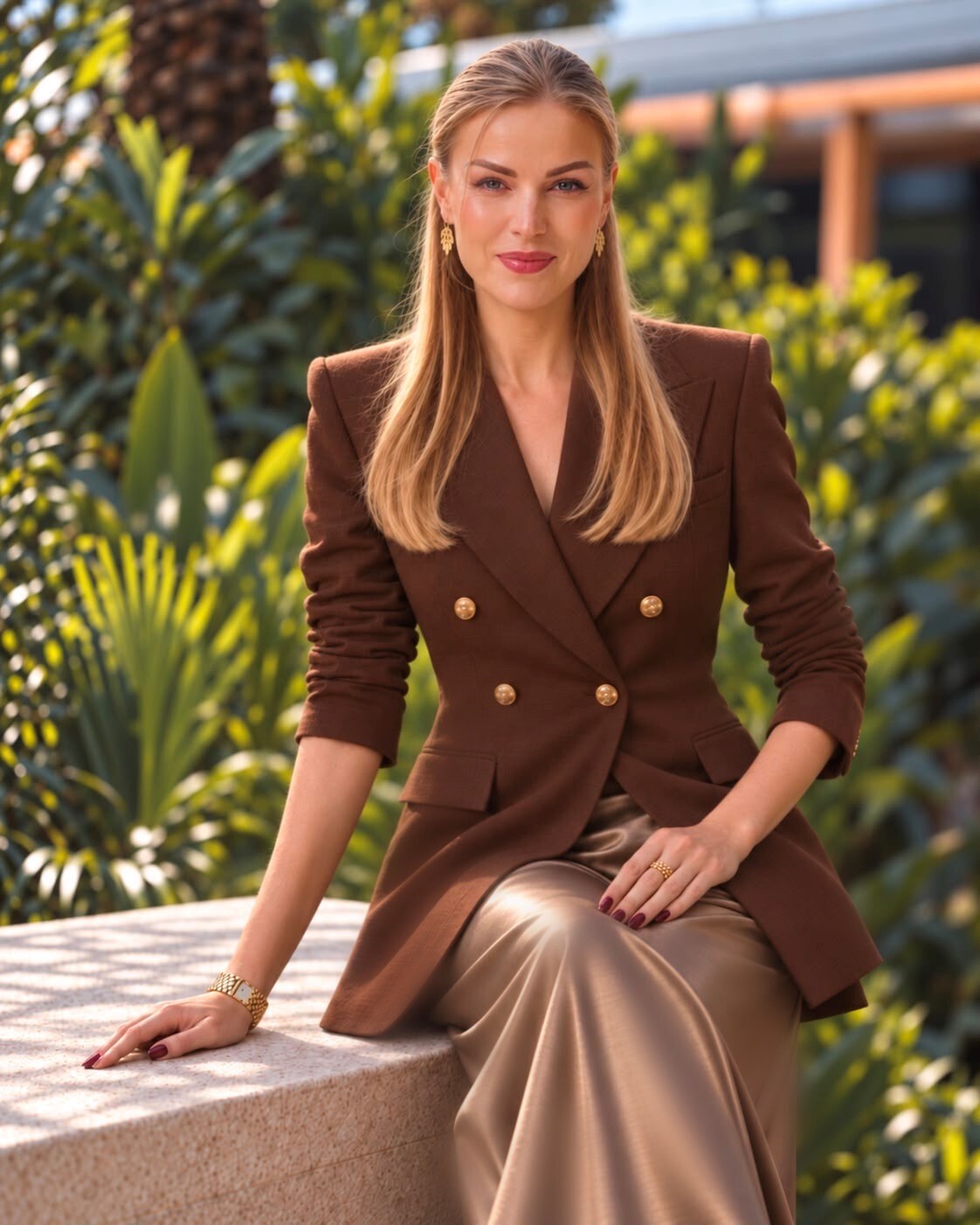
Today, as General Manager of Meliá Desert Palm, she is championing a more intimate approach to luxury hospitality, where privacy, personalised experiences and wellbeing take centre stage. Her leadership philosophy reflects the same belief: exceptional guest experiences begin with empowered teams, a culture of trust and an environment where people feel valued.
In this interview, Pavlina reflects on her journey, her approach to leadership and her vision of a luxury experience that gives guests the freedom to slow down, reconnect and feel genuinely cared for.
You are a third-generation hotelier and started working in your family's properties when you were just 12. What is the first image or memory that comes to mind when you think about those early days in hospitality?
My earliest memories actually go back to when I was around eight years old, exploring the back-of-house areas of our family hotel in Prague.
I remember the beautiful wooden reception desk, the old-fashioned boards filled with room keys, almost like something from The Grand Budapest Hotel. Then there were the mysterious corridors leading to the food and beverage storerooms and housekeeping areas, always carrying the beautiful scent of freshly washed linen.
As a child, those basement corridors without daylight felt slightly frightening and magical at the same time.
But what I remember most vividly are the people. The hotels felt like a second home, filled with kind, welcoming colleagues whom I regarded almost as aunts and uncles. There always seemed to be freshly baked pastries and cakes somewhere, and someone willing to share one.
Looking back, I think I was fortunate to experience hospitality before I understood it as a business. I experienced it as a feeling of belonging. Perhaps that is why I still believe that the most memorable hotels are not necessarily those with the most impressive facilities, but those that make people feel genuinely welcome.
Growing up surrounded by hotels must have given you a very different perspective on the industry. Was there something you learned as a child that you still carry with you as a General Manager today?
I learned quite early that hospitality is an extraordinarily demanding profession, physically, mentally and emotionally. But I also witnessed how deeply rewarding it can be.
There is something rather special about creating an experience for someone and seeing their genuine reaction. A guest remembering a colleague's name, expressing sincere appreciation or returning years later because of how they felt during their previous stay. Those moments are difficult to quantify, yet they are at the very heart of our industry.
I also learned that hospitality is never the achievement of one individual. A beautiful guest experience is the result of countless people, many of whom the guest will never meet.
Today, as a General Manager, I see my responsibility as creating the conditions in which those people can do their best work. Because ultimately, the emotional experience we promise our guests must begin with the culture we create for our employees.
Your career has taken you from Prague to the UAE, through brands such as Ritz-Carlton, JW Marriott and Meliá. Was there a particular moment or move that made you realise you were building a career beyond the family business?
Initially, my motivation was quite simple: I wanted to know whether I was genuinely capable of succeeding in hospitality outside my family's business.
Being a third-generation hotelier is a privilege, but I was determined not to rely on my surname or my father's appreciation of my abilities.
My early experience with Autograph Collection in Prague was formative. The hotel occupied a magnificent former bank dating back to the late nineteenth century, combining historic architecture with luxury accommodation, wellness and sophisticated gastronomy. It opened my eyes to how many different disciplines come together to create a compelling hotel experience.
The real turning point, however, was joining the pre-opening team of JW Marriott Marquis Dubai, at the time the world's tallest hotel.
Moving from Prague to Dubai, and from a relatively intimate hotel environment to one of the world's most ambitious hospitality projects, was an extraordinary learning experience.
Over time, I also discovered something important about my own professional interests. While I value the discipline and operational sophistication of large international hotels, I am increasingly drawn to boutique luxury properties, where there is greater opportunity to create a distinctive identity, cultivate meaningful relationships and shape an experience that cannot easily be replicated.
Today, that intersection of brand strategy, commercial performance, wellbeing and highly personalised hospitality is where I find the greatest professional fulfilment.
You have often spoken about humility and the importance of understanding every role within a hotel. Having started from the bottom yourself, how has that experience shaped the way you lead your teams today?
I often say that hospitality is a team sport.
Every person contributes to the success of a property, whether they are welcoming guests at reception, preparing a room, maintaining the gardens or managing the commercial strategy.
Having worked my way through different operational environments, I understand the complexity and demands of these roles. It is very difficult to lead people effectively if you do not appreciate what their work involves.
But I also believe that good leadership requires more than empathy. It requires clarity, accountability and the courage to make difficult decisions.
My responsibility is to establish a clear vision, ensure that everyone understands where we are going, and give people the freedom to contribute their ideas and challenge existing practices.
I am not particularly interested in creating a culture where everyone agrees with the General Manager. I would much rather work with people who think independently, take ownership and have the confidence to speak up.
Respect and accountability should coexist. In fact, I believe the strongest teams are built on precisely that combination.
Meliá Desert Palm is unlike many luxury resorts in Dubai: horses, polo fields, nature and a sense of space are at the heart of the experience. What was it about this place that felt personally right for you when you arrived?
The potential. Almost immediately, I could see what Desert Palm could become.
Here was this extraordinary private polo estate, surrounded by greenery and horses, just minutes from one of the world's most dynamic cities. Yet its true potential as an intimate luxury retreat had not been fully realised.
I was convinced that the expectations of high-net-worth and ultra-high-net-worth travellers were evolving. Beyond beautiful accommodation and impeccable service, there was growing demand for privacy, authenticity, space, wellbeing and experiences that feel genuinely personal.
I also believe that scale matters enormously in luxury hospitality.
A large hotel can deliver an exceptional luxury product, but creating the intimacy, discretion and individual recognition expected by certain UHNW travellers becomes increasingly challenging as the number of rooms grows.
This is where smaller properties have a natural advantage. When a hotel has only a few dozen rooms and villas, there is a greater opportunity to understand guests individually, anticipate their needs and create an atmosphere that feels closer to a private residence than a conventional resort.
With Desert Palm, I saw an opportunity to build precisely that proposition.
Our Al Waha Collection of private pool villas, the evolution of SAMĀNA Spa and our focus on personalised wellness are all extensions of the same long-term vision.
What is particularly rewarding is that the growing global interest in privacy, restorative travel and boutique luxury has not required us to fundamentally change direction. It has largely validated the positioning we believed in from the beginning.
For me, that is the difference between following a trend and building a brand with a clear identity.
You describe hospitality as being increasingly about the intangible: connection, emotion and meaningful moments rather than simply beautiful surroundings. Can you remember a guest experience that made you realise how powerful those invisible details can be?
We had an ultra-high-net-worth guest who had traditionally stayed with one of the world's most renowned luxury hospitality brands. After experiencing Meliá Desert Palm, he decided to make us his preferred hotel in Dubai.
What stayed with me was his explanation.
He told us that marble bathrooms and gold-plated taps, beautiful as they may be, were no longer what defined luxury for him. What he valued far more was genuine privacy, something he felt had become increasingly difficult to find at his previous hotel, where the presence of influencers and constant content creation had changed the atmosphere.
At Desert Palm, he found something different. A sense of discretion, intuitive service and the freedom to enjoy time with his family without feeling observed.
We were able to create completely personalised experiences for his daughter through our riding school, alongside thoughtfully designed, themed amenities reflecting her interests. None of these gestures required extraordinary expenditure. They required attention, creativity and a genuine understanding of the family.
For me, his decision to return to us rather than to a globally renowned ultra-luxury property was particularly meaningful. It confirmed something I have believed for a long time: the true measure of luxury is not how much a hotel has invested in its physical product, but how well it understands the individual guest.
Beautiful interiors can be replicated. Genuine relationships, trust and the feeling of being completely at ease are much harder to create.
And perhaps that is the ultimate luxury today: to feel genuinely cared for, without ever feeling on display.
Horses and nature seem to have a special place in your life. Has your relationship with horses ever influenced the way you understand leadership, teamwork or even people?
Horses teach you something very important about authenticity.
You cannot impress a horse with your job title, your experience or your authority. They respond to behaviour, consistency, clarity and the way you make them feel.
I think there is a valuable leadership lesson in that.
A leader needs to know where the team is going and communicate that direction clearly. But leadership is not about controlling every movement. It is about building trust, creating confidence and allowing individuals to contribute while remaining aligned around a common objective.
Horses are also highly social animals. They depend on awareness, communication and cooperation within the herd.
The parallel with hospitality is quite beautiful. Our industry depends on people who must work together, often under pressure, with an extraordinary degree of coordination.
I believe in giving people freedom to experiment, make decisions and occasionally make mistakes. But freedom must come with accountability, and individuality must never undermine the collective purpose.
Perhaps the greatest lesson is that trust cannot be demanded. It has to be earned through consistent behaviour.
You speak openly about giving yourself and your teams space to recharge and about finding a healthier balance between professional and personal life. What have you personally had to learn about slowing down while working in such a demanding industry?
One of the most important lessons is that being permanently busy is not necessarily the same as being effective.
Hospitality has historically celebrated long working hours, personal sacrifice and the ability to operate under constant pressure. I think we need to challenge that culture.
Exhausted, stressed or disengaged employees cannot consistently deliver the emotional intelligence and genuine care that luxury hospitality requires.
There is also a very clear commercial argument. High employee turnover, burnout, poor communication and unhealthy organisational cultures come with an enormous cost, financially and operationally.
At Meliá Desert Palm, we have worked to make wellbeing part of the organisational culture through HostWell, our employee wellbeing programme covering physical health, emotional balance, professional growth, community and purpose.
The results have reinforced my conviction that caring for people is not separate from business performance. It is one of its foundations.
I am also learning that slowing down does not necessarily mean doing less. Sometimes it means creating enough mental space to think more clearly, make better decisions and focus on what genuinely matters.
That is something I continue to work on myself. I would be rather suspicious of any hotelier claiming to have mastered work-life balance completely.
You are currently pursuing an Executive Master's in Luxury Management and Customer Experience after already building a substantial career in hospitality. What made you want to go back to studying and what are you still curious to learn?
Curiosity, predominantly.
When I completed my first hospitality degree, subjects such as brand equity, customer experience design and the psychology of luxury consumption were not explored with the same sophistication they are today.
Yet these disciplines have become increasingly central to the future of hospitality, particularly within boutique luxury.
I wanted to understand more deeply why certain brands develop such extraordinary emotional connections with their customers, how that translates into commercial value, and how experiences can be designed without losing authenticity.
I also wanted to challenge my own thinking.
After years in operational leadership, it is surprisingly easy to become convinced that your experience provides all the answers. Returning to an academic environment forces you to examine assumptions, engage with different perspectives and reconsider practices you may have taken for granted.
Glion offered the academic rigour and international perspective I was looking for.
I am particularly interested in the intersection of luxury brand strategy, behavioural psychology, wellbeing and technology.
As AI increasingly changes how guests discover, select and interact with hotels, I believe the ability to combine technological sophistication with genuine human connection will become one of the defining capabilities of successful luxury hospitality leaders.
I do not think professional experience should ever become an excuse to stop learning.
If you could redefine luxury in your own words today, after everything you have experienced, what would luxury mean to you and what would you like guests to feel when they leave Meliá Desert Palm?
I believe luxury is increasingly about freedom.
Freedom from noise, from unnecessary decisions, from expectations and, perhaps most importantly, from the constant pressure to be doing something.
For years, our industry has competed by offering more: more facilities, more restaurants, more activities, more elaborate wellness programmes.
But I think a growing number of discerning travellers are looking for something rather different.
They want to feel understood without having to explain themselves. They want privacy without isolation, meaningful experiences without excessive scheduling, and service that anticipates their needs without becoming intrusive.
Sometimes the most luxurious thing we can offer is not another experience, but the freedom to simply be.
That is very much what we are trying to cultivate at Meliá Desert Palm.
I would like our guests to leave feeling that they have genuinely disconnected from the demands of everyday life, reconnected with themselves or the people they love, and experienced a sense of peace that stays with them after their departure.
Beautiful surroundings may attract someone to a hotel. How they feel when they leave is what makes them want to return.
On a More Personal Note
If you were a horse breed:
This genuinely made me laugh, but to answer- An endurance horse rather than a sprinter. I believe in resilience, consistency and having the stamina to go the distance.
If you were a place in the world where you instantly feel at peace:
Mountains and forests. There is something about their scale, silence and natural rhythm that immediately puts everything into perspective.
If you were a ritual you would never give up:
A good night's sleep. Perhaps not the most glamorous answer from someone working in luxury wellness, but increasingly I believe it is one of life's greatest luxuries.
If you were to teach your children one thing about hospitality:
That genuine human connection will always matter. Technology, expectations and the world around us will change, but the ability to make another person feel seen, respected and cared for will never lose its value.
If you were a sentence that reflects the way you want to live and lead:
“Be stubborn about your vision, but flexible about how you achieve it.”